

Plasma Treatment for Surface Activation
Coatings and films that bead, pool or peel are rarely a formulation problem. They're a surface-energy problem plasma activation solves before the material goes on.
Paint that beads instead of laying flat, a photoresist film that pools in some spots and thins in others, a thin film that won't nucleate evenly across a substrate — these read like formulation or process problems, and sometimes they are. Just as often, the coating, resist or film was asked to wet and bond to a substrate that never had the surface energy to receive it properly. Surface activation is the plasma step that fixes that before the coating, resist or deposition process ever starts.
Why low surface energy shows up as a coating defect
Surface energy is a property of the molecules sitting at a material's surface: unlike molecules in the bulk, which are fully surrounded by like molecules on every side, surface molecules face an imbalance of forces, and that imbalance determines how readily a liquid or vapour-phase material spreads across it. A low-energy surface — an as-moulded plastic, an oxidised metal, a substrate carrying handling residue — resists wetting. A paint or ink beads or pulls back at edges instead of forming a continuous film. A photoresist spun onto a contaminated wafer pools instead of spreading to a uniform thickness. A thin film deposited by ALD or PVD nucleates unevenly across a surface that doesn't present consistent reactive sites. In every case, the defect traces back to the interface, not to the coating material itself.
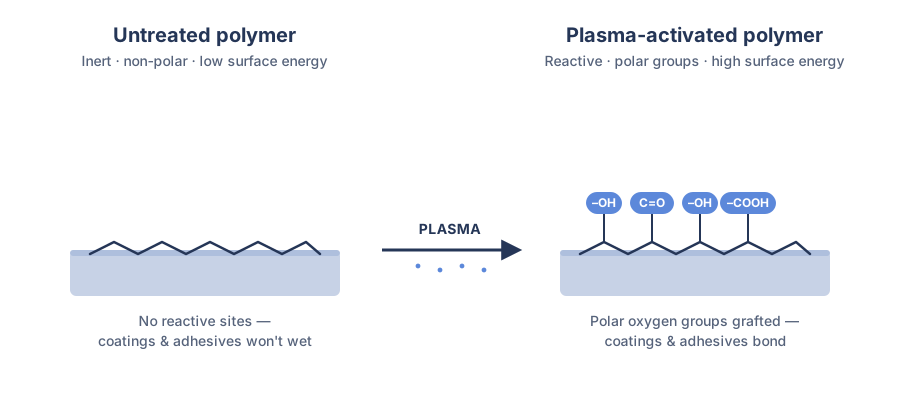
How plasma activation increases surface energy
Plasma is a partially ionised gas — a mix of ions, electrons and reactive neutral species generated by applying an electric field to a process gas inside a vacuum chamber. When that plasma contacts a surface, the energetic particles break molecular bonds at the surface and create new, more reactive functional sites in their place. That reactivity is what raises surface energy: the newly exposed molecular ends are more polar and more attracted to the polar molecules common in paints, adhesives and coating formulations, which is what lets the coating spread into a continuous film instead of beading. The gas used shapes the result — argon, oxygen, nitrogen and hydrogen are the common choices, each contributing different surface chemistry depending on what the next process step needs. And because most plasma activation runs at or near room temperature, it modifies the surface this way without the thermal exposure a wet-chemical or high-temperature process would add, which matters for temperature-sensitive substrates.
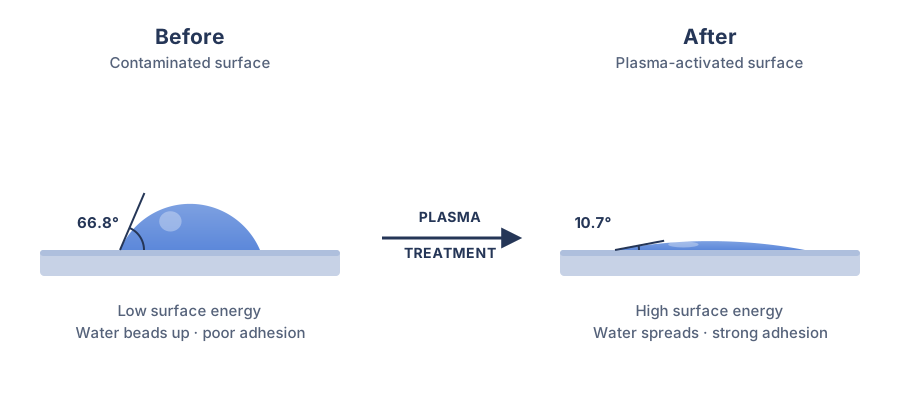
Where plasma activation sits in the process
Plasma activation is a pre-treatment step, run immediately before painting, spin coating or deposition. Ahead of painting, it replaces or reduces the mechanical abrasion — sanding, blasting — traditionally used to prepare a surface, and because it's a dry, non-contact process, it doesn't stress or damage the substrate the way abrasive prep can. Ahead of spin coating, it removes organic contamination and raises wettability so photoresist spreads evenly across the wafer rather than pooling or thinning at the edges, which is what determines a uniform film thickness going into the lithography step. Ahead of plasma-assisted ALD, the same activation effect improves how well the deposited film adheres to the substrate, and because plasma lets the ALD reaction itself run at a lower temperature than thermal ALD requires, it extends the process to heat-sensitive substrates — polymers and temperature-sensitive electronic components — that couldn't otherwise take the coating.
The right system depends on part size, batch volume, and how much plasma energy the process needs:
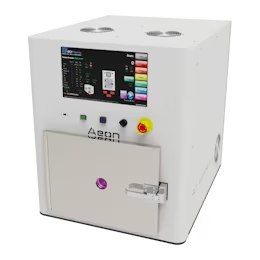
- Aeon — a table-top batch system for lab qualification and lower-volume production, with applications spanning coating prep (PVD, CVD, electroplating, ALD, dip and spin coating), paint prep, and plastics activation.
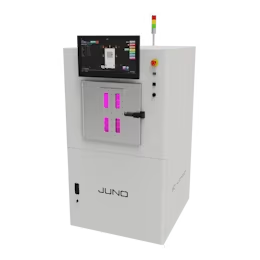
- Juno — a batch system whose reconfigurable shelves adapt to almost any part shape, so varied or awkwardly shaped parts needing activation run together in one chamber rather than one at a time.
Verification
Contact-angle measurement is the direct, fast check on activation: it quantifies wettability before and after treatment, and a surface that still resists wetting after plasma exposure points to a chamber or recipe issue rather than a bad batch of parts. Downstream, adhesion testing on the finished coating — cross-hatch or peel testing on paint, film-thickness uniformity on a spin-coated wafer — ties the activation step back to yield. Surface energy decays over time after treatment, so parts should move to the coating or deposition step promptly rather than sitting exposed to ambient air and dust.
Recommended systems
Related industries
Related articles
Plasma Treatment and Its Impact on Surface Energy
Strong and durable bonds are vital for product reliability and performance in various industrial applications, including metals,...
The Uses of Plasma Cleaning Before Painting
As industries continuously seek more efficient, cleaner, and versatile methods to prepare surfaces, plasma cleaning is clearly an...
The Uses of Plasma Cleaning Prior To Spin Coating
Plasma cleaning before spin coating ensures the substrate is free from contaminants and optimizes surface properties for better film...
Frequently asked questions
Why does paint or coating peel even when the formulation is correct?
Peeling, beading and pinholes are usually a surface-energy problem, not a formulation problem — a low-energy or contaminated substrate doesn't let the coating spread into a continuous film, no matter how well the coating itself was engineered.
What actually happens to a surface during plasma activation?
Energetic particles in the plasma break molecular bonds at the surface and create new, more reactive functional sites. Those sites are more polar and more attracted to the polar molecules in coatings and adhesives, which raises the surface energy and improves wetting.
Does plasma activation replace mechanical abrasion like sanding or blasting?
In most cases, yes. Plasma is a non-contact, dry process that reaches the same surface-energy result without the labour and substrate stress that sanding or abrasive blasting adds.
Why is plasma activation used ahead of spin coating and ALD?
For spin coating, it raises wettability so photoresist spreads evenly rather than pooling or thinning at the edges. For plasma-assisted ALD, it improves film adhesion and lets the deposition run at a lower temperature, extending the process to heat-sensitive substrates that thermal ALD can't coat.
Which plasma system fits a surface-activation step?
It depends on part size and mix: Aeon for lab qualification and lower-volume batches, and Juno where varied or awkwardly shaped parts need to be activated together in one chamber without a dedicated carrier.