

Plasma Cleaning for Automotive Manufacturing
From power-module wire bonds to structural adhesive joints and electrical contacts, a contaminated surface is the same failure waiting to happen. Vacuum plasma treatment removes it before assembly, not after a warranty claim.
Modern vehicles run on bonds as much as on fasteners. Structural adhesives hold lightweight polymer trim and body panels together in place of rivets and screws, EV power modules depend on wire bonds and transfer-molded packages that must survive a decade of thermal cycling, and ADAS sensors, airbag controllers and connector pins depend on electrical contacts that stay conductive for the life of the car. Every one of those joints forms across a surface, and if that surface carries mould-release residue, machining oil or a layer of oxide, the joint is compromised before assembly even starts.
The problem: adhesion and contact reliability under warranty pressure
Automotive components are expected to survive road-salt exposure, vibration and thermal cycling for years without the bond, coating or contact failing — a hard target when the surface being bonded, painted, welded or connected starts with a contamination layer already on it. Low-surface-energy polymers like polyethylene and polypropylene, now standard in interior trim and under-hood parts for weight reduction, are naturally resistant to adhesive wetting: the surface energy an adhesive needs to spread and key into the material simply isn't there untreated. Oxide layers on aluminium, steel and copper block both weld penetration and reliable electrical contact. Flux residues, mould-release agents and machining oils sit as a barrier between a coating or adhesive and the substrate underneath.
The downstream symptoms rarely show up as a line-side reject — they show up as a warranty claim. A trim adhesive that lets go after repeated thermal cycling, a headlight lens coating that delaminates, a rubber-to-metal engine mount bond that fails under vibration, an ECU or airbag connector that develops intermittent continuity as oxide regrows on a pin. None of these are fixed by specifying a stronger adhesive or a better connector plating — the surface underneath was already working against the process.
Where vacuum plasma cleaning fits
Vacuum plasma treatment addresses the surface directly, immediately before the step that depends on it — painting, bonding, welding or making electrical contact — rather than after a failure gets traced back to it weeks later. Inside a vacuum chamber, a process gas is ionised into plasma: argon for inert, physical removal of oxide layers without altering the surface chemistry underneath; oxygen for oxidising away organic residues and machining oils; hydrogen for reducing metal oxides back to a bare, conductive surface. The same treatment that strips a lead frame for wire bonding also raises the surface energy of a polymer trim panel enough to bond it without a mechanical fastener.
Part geometry varies enormously across a vehicle — from flat lead frames to contoured trim and housings — so chamber configuration matters. A reactive-ion-etching (RIE) configuration, with the part on the powered electrode, delivers a more aggressive, directional treatment suited to metal-oxide removal and weld prep. A plasma-etching (PE) configuration, with the part grounded, is gentler and better suited to polymers and sensitive electronics. Both are tunable on gas mix, RF power, pressure and cycle time, so one system can be requalified between a metal batch and a polymer batch without a hardware change.
Where it sits in the manufacturing line
- Adhesive bonding — activates low-surface-energy polymers in interior trim, under-hood panels and rubber-to-metal joints (engine mounts, suspension bushings, exhaust hangers) so adhesives bond without added mechanical fasteners, supporting weight-reduction targets.
- Paint and coating preparation — removes oils and residues from body panels and lens materials ahead of painting or protective coating, improving finish quality and coating durability.
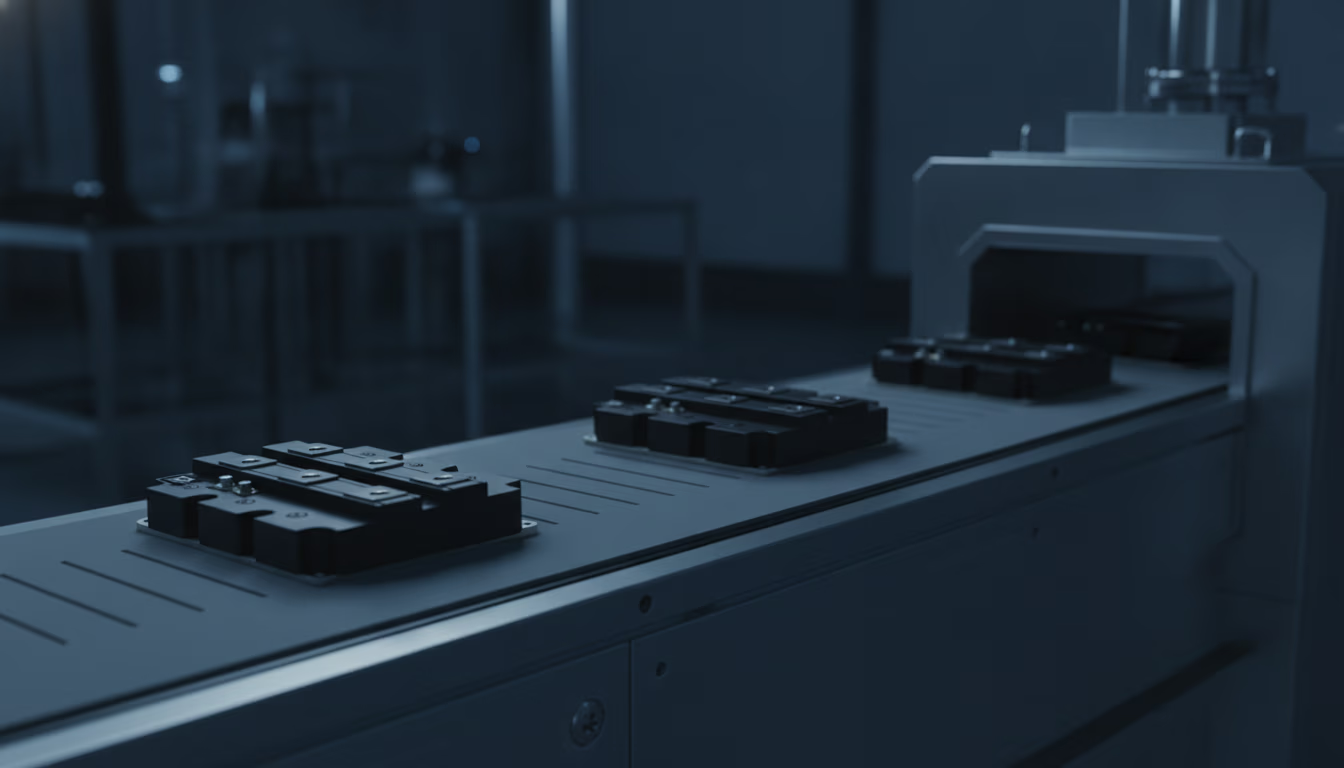
- Wire bonding and transfer molding on power modules — strips oxides and organics from lead frames and substrates ahead of IGBT and power-MOSFET module assembly, the same failure mode that affects semiconductor packaging generally.
- Welding preparation — removes oxides, grease and dirt from joint surfaces ahead of welding, reducing porosity and weld defects.
- Electrical contacts and sensors — cleans connector pins, circuit boards and sensor housings so ECU, airbag and ADAS systems keep reliable conductivity.
- Gasket sealing — improves seal-surface wetting on engine, transmission and cooling-system components, supporting leak resistance.
Matching the system to the line
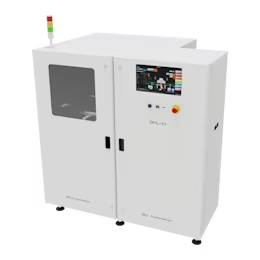
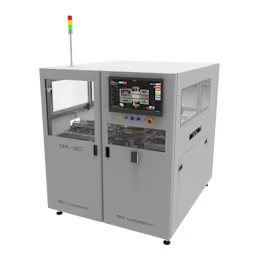
QML-B is purpose-built for automotive-parts carriers: at 480 mm wide it's the narrowest inline plasma system on the market, designed for lines where footprint is the constraint rather than throughput, with full front-and-back access to keep maintenance fast on a 24/7 line. QML-CI is the higher-throughput inline platform, in service on power-module lines — IGBTs, power MOSFETs — since 2015, with a conveyor-indexer that loads and unloads the chamber in a single motion and traceability options for MES integration. QML-2CI is the dual-lane version of that platform, running two lanes in parallel through a single footprint to double inline throughput where one lane can't keep pace with the assembly line.
Verifying the result
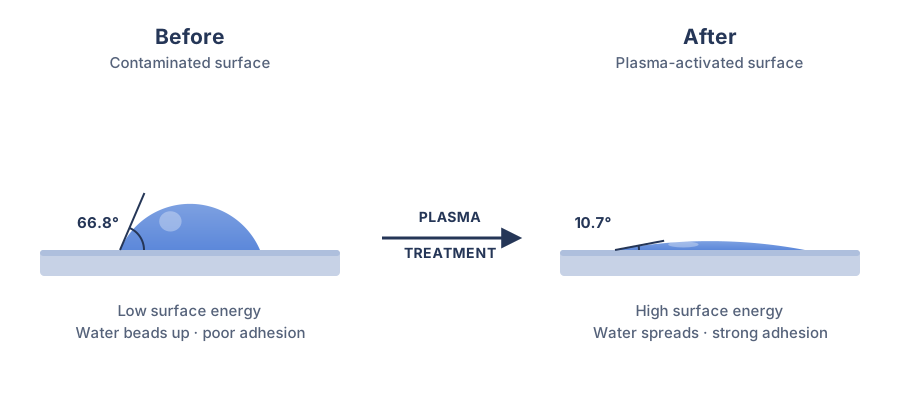
A plasma step that's running but not measured is a step you're trusting on faith. Contact-angle measurement before and after treatment is the fastest check available on the line — it tracks the same surface-energy shift that drives adhesive bonding and paint adhesion, and a result drifting back toward the untreated baseline is an early warning of a fouled chamber or a depleted gas line before it shows up as a field return. Downstream, correlating plasma cycle records against pull-test results on bonded trim, wire-bond shear data on power modules, or continuity testing on connector assemblies closes the loop between the surface-prep step and the metric that matters for a part expected to survive a decade on the road.
Related applications
See it in production
Read the case studyRelated articles
Plasma Cleaning in the Automotive Industry
The automotive manufacturing industry is always on the lookout for better methods to improve product quality and production efficiency....
Plasma Treatment In The Automotive Industry
Plasma treatment processes are used to improve the adhesion of a wide range of automotive parts
Plasma Treatment for Enhanced Polymer Bonding
In today's fast-evolving industries, from automotive to biomedical devices, the demand for strong, durable, and reliable polymer bonding...
Frequently asked questions
What does plasma treatment actually remove from an automotive part's surface?
Oils, mould-release residue, oxide layers and machining contaminants, while simultaneously raising the surface energy so adhesives, paints, coatings and solder wet the surface instead of resisting it.
Can one plasma system treat both metal lead frames and plastic trim components?
Yes, with different recipes on the same platform — an RIE (powered-electrode) configuration suits metal oxide removal and weld prep, a gentler PE (grounded-electrode) configuration suits polymer activation; gas, power and cycle time are tuned per part.
Why does a trim adhesive bond fail even when the adhesive itself is rated strong enough?
Automotive weight-reduction designs increasingly bond low-surface-energy polymers like PE and PP without mechanical fasteners. Untreated, those polymers resist wetting regardless of adhesive strength, so the bond fails under thermal cycling or vibration before the adhesive's rated strength is ever tested.
Which system fits an automotive line — QML-B, QML-CI or QML-2CI?
QML-B suits automotive-parts carriers where machine footprint is the constraint; QML-CI suits high-throughput 24/7 power-module lines; QML-2CI runs two lanes in parallel for the highest throughput where a single inline lane can't keep pace.
How do we confirm the plasma step is still working, not just running?
Track water contact angle before and after treatment as a direct surface-energy check, and correlate plasma cycle logs against pull-test, wire-bond shear or connector-continuity results so a drifting chamber is caught before it becomes a warranty claim.