

Plasma Cleaning for Die Attach
A die that doesn't hold to its lead frame is rarely an epoxy problem. It's a frame surface the epoxy was never given a chance to wet.
Die attach is the step where a die is bonded to its lead frame or substrate, usually with an epoxy adhesive that has to cure into a mechanically stable, thermally conductive joint. When that joint comes back with low shear strength, voiding, or inconsistent pull-test results across a lot, the epoxy formulation and cure oven are the usual suspects — but in persistent cases, the epoxy is being asked to bond to a lead frame surface that was never prepared to receive it.
Why die-attach bonds fail even when the epoxy process is correct
Incoming lead frames don't arrive with uniform surface condition — different lots, different upstream handling, different exposure time between plating and die attach all leave different levels of oxide and organic residue on the frame. If the surface-prep step applies the same treatment regardless of what's actually on the frame, it can clean the lightly contaminated lots and under-clean the worst ones, and that variability shows up downstream as exactly the symptoms described above: inconsistent pull-test values, occasional low-shear lots, non-stick events. It's tempting to chase that variability in the epoxy dispense or cure parameters, but the more common source is the surface the epoxy was applied to.

How plasma cleaning stabilises the die-attach bond
Plasma treatment prepares the lead frame surface in the same three ways it prepares any bonding interface: it cleans away oils and oxide through physical sputtering and chemical reaction with the plasma species, it etches the surface at a microscopic level to create additional sites for mechanical interlocking, and it activates the surface by increasing its energy so the epoxy is more reactive and wets it fully instead of resisting it. Argon is the standard gas for contamination removal; oxygen is more aggressive against organic residue because it oxidises it directly. Because plasma parameters are set once and repeated exactly on every cycle, the treatment isn't guessing at how contaminated a given frame is — it applies a worst-case-standard clean to every frame, which is what removes the lot-to-lot variability that shows up as inconsistent pull-test data.
Where plasma cleaning sits in the process, and how to keep it that way
Plasma cleaning is introduced as a pre-treatment step immediately ahead of die attach, and because it's the step that removes the largest source of bond variability, it's worth treating as a monitored process rather than a black box. A small oxygen leak into the chamber or a pressure imbalance can undermine an entire cleaning cycle without an obvious symptom — the frames still look clean — until pull-test data starts drifting. Building the process around a deterministic standard, where the chamber is verified to handle the worst-case contamination it will ever see rather than the average lot, is what turns die attach from a source of occasional rejects into a controlled step.
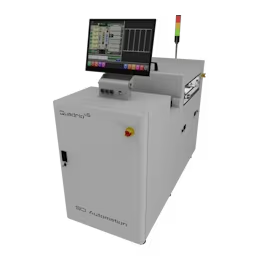
- Quadrio Alpha — a magazine-fed system for lead frames: each frame is pulled from its magazine, plasma-treated, and returned to the same magazine, running four magazines concurrently in the Alpha 4 configuration or five in the Alpha 5, with per-frame traceability for MES integration. It's the standard configuration ahead of die attach on lead-frame packages.
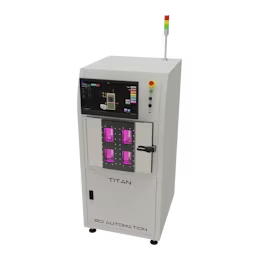
- Titan — a magazine-fed batch system for lead frames, holding up to six magazines in fixed positions so every frame is treated evenly regardless of magazine size, covering the same lead-frame prep ahead of die attach with in-place handling that suits fragile or already-bonded frames.

Verifying the die-attach interface
The metric that ties the plasma step back to yield is the same one that exposes drift early: pull and shear-test trending on the bonded output, tracked lot over lot rather than checked pass/fail at a single threshold. A chamber that's drifting shows up here before it shows up as a field failure — which is the difference between catching a process problem on the line and finding it in a returned part.
Recommended systems
Related industries
Related articles
Bond Strength and Yield: Engineering Stability into Every Frame
Bond strength isn't a constant—it's the outcome of surface prep, material control, and the process environment. When failures occur,...
The Uses of Plasma Cleaning Prior To Epoxy Bonding
Plasma treatment is a critical step in ensuring the efficacy and durability of epoxy bonds in various industrial applications. Its...
Frequently asked questions
Why does die-attach bond strength vary lot to lot even when the epoxy process hasn't changed?
Incoming lead frames don't carry uniform contamination — different lots and upstream handling leave different levels of oxide and residue on the surface. If the cleaning step isn't strong enough for the worst-case lot, that variability shows up downstream as inconsistent pull-test values and occasional low-shear results.
What does plasma cleaning actually do to the lead frame before die attach?
It cleans off oils and oxide, etches the surface to add mechanical interlocking sites, and activates the surface by raising its energy so the epoxy wets and bonds to it more fully.
Can a plasma chamber drift without anyone noticing?
Yes — a small oxygen leak or pressure imbalance can undermine an entire cleaning cycle without an obvious symptom, since the frames still look clean. It typically shows up later as pull-test data trending down, which is why chamber integrity checks belong in the same maintenance cadence as the rest of the line.
Which plasma system fits a die-attach line running lead frames?
Quadrio Alpha is purpose-built for this: a magazine-fed system that pulls each frame out, plasma-treats it, and returns it to the same magazine, with per-frame traceability. Titan is the magazine-fed batch alternative, holding up to six magazines and handling fragile or already-bonded frames gently.