

Plasma Cleaning for Underfill
Voiding and corner cracking under the underfill epoxy usually start with a die or substrate surface the epoxy never fully wetted. Plasma cleaning fixes that before dispense.
Underfill is an epoxy dispensed into the gap between a flip-chip die and its substrate to redistribute thermal stress across the joint and protect it from moisture and contamination. It only does that job if the epoxy fully wets and bonds to both surfaces — and when it doesn't, the result is voiding, incomplete fillet formation, or corner cracking that shows up not at dispense but later, once the assembly goes through thermal cycling.
Why underfill epoxy voids and delaminates
Underfill is a bonding process like any other: an epoxy resin and hardener that react to form a rigid, adhesive layer between two surfaces, and an outcome that depends on how well that resin wets the surfaces it's asked to fill against. A die or substrate surface carrying oxide film, flux residue or handling oils gives the epoxy less to key into — voids form where the resin can't displace the contamination, and the interface stays weaker than the cure profile was designed to deliver. As with any bonded interface, that weakness doesn't always fail at dispense; it fails later, once thermal cycling or moisture exposure puts the joint under enough stress to separate.
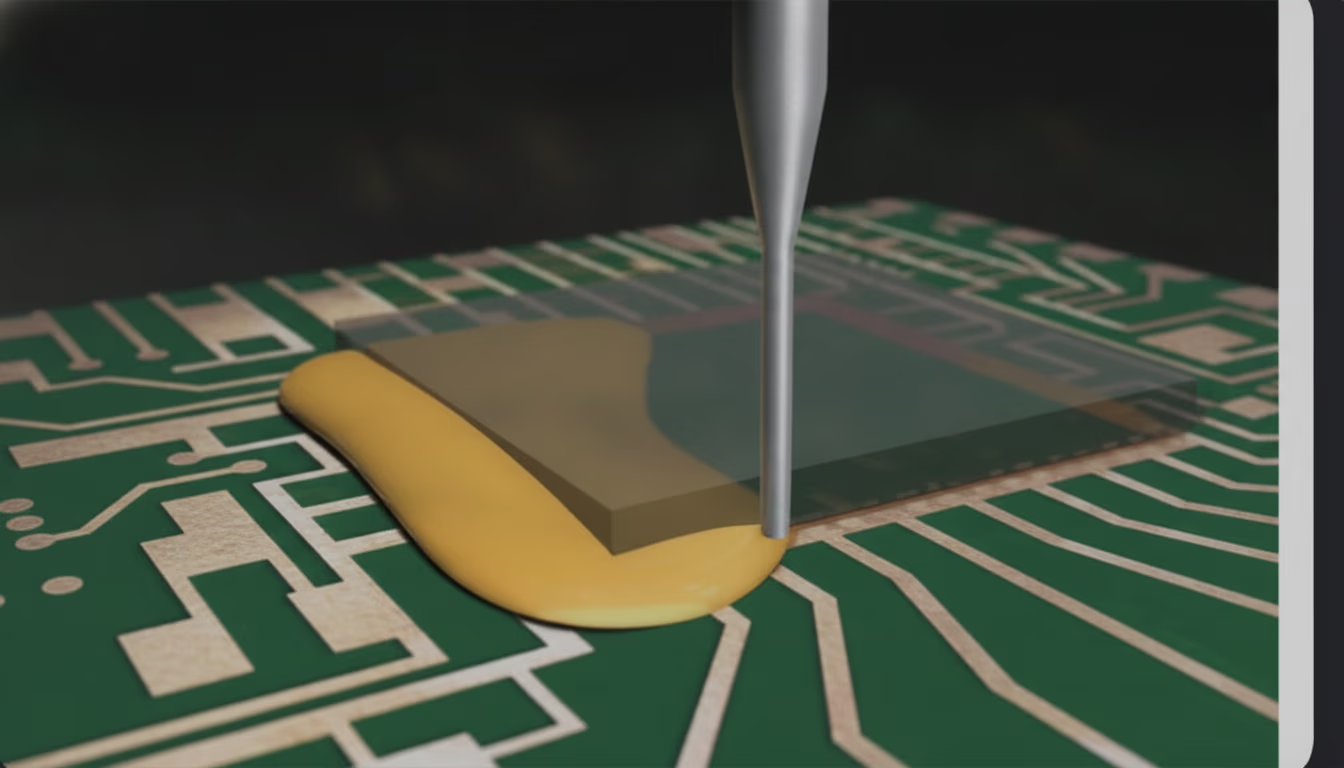
How plasma cleaning improves epoxy wetting before dispense
Plasma treatment prepares the die and substrate surface in three ways at once: it cleans, removing oils and residue through a combination of physical sputtering from high-energy plasma particles and chemical reaction with the plasma species; it etches, microscopically roughening the surface to create more sites for mechanical interlocking; and it activates, raising the surface energy so the epoxy is more reactive and wets the surface instead of beading against it. Gas selection determines the balance — argon or oxygen are the typical choices, and oxygen in particular is effective at oxidising away organic contamination. Because these process parameters (gas, power, pressure, duration) are precisely controlled and repeatable, the same treatment is delivered to every die and substrate that passes through the chamber, not just the ones an inspector happened to sample.
Where plasma cleaning sits in the process
Plasma cleaning is introduced as a pre-treatment step immediately before underfill dispense, and the system choice comes down to part format and volume:
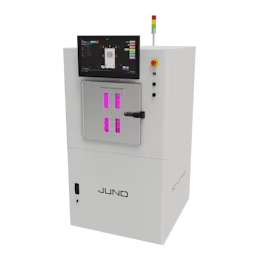
- Juno — a batch system whose reconfigurable shelves adapt to almost any part shape, so mixed flip-chip, BGA and module substrates ahead of underfill run together in one chamber without a dedicated carrier, suited to lab qualification and lower-volume production.
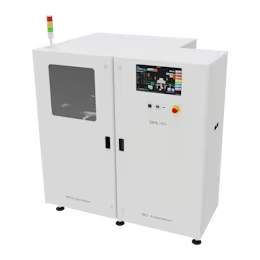
- QML-CI — an inline system with a conveyor-indexer that loads and unloads the plasma chamber in a single motion, built for 24/7 continuous processing of the same PCB and BGA substrates that carry an underfilled die, matched to high-volume module lines.
Either configuration sits ahead of the dispense step without restructuring it — the die or substrate is treated, then moves directly to underfill without an intermediate handling stage that could reintroduce contamination.

Verifying the underfill interface
Because underfill voiding is largely invisible until an assembly is stressed or inspected internally, verification has to close the loop rather than assume the plasma step worked. A break test on sacrificial parts distinguishes a bond that formed from one that didn't: a clean separation into two smooth surfaces means the epoxy never keyed into the surface, while material transfer between the two sides means the interface is as strong as the materials themselves. For assemblies that need to stay intact, acoustic microscopy reads how sound waves travel through the underfill layer to find voids and weak bonding non-destructively — the same inspection method used to catch delamination in any bonded interface, applied here to the fillet under the die.
Recommended systems
Related industries
Related articles

How Plasma Cleaning Solves Delamination Risks in Multi-Material Assemblies
When two materials don't bond properly, failure is often only a matter of time. Delamination—where bonded surfaces separate under stress...
The Uses of Plasma Cleaning Prior To Epoxy Bonding
Plasma treatment is a critical step in ensuring the efficacy and durability of epoxy bonds in various industrial applications. Its...
Frequently asked questions
Why does underfill epoxy void even when the dispense process is dialed in correctly?
Voiding is usually a wetting problem, not a dispense problem: oxide film or residue on the die or substrate gives the epoxy less surface to key into, so it can't fully displace the contamination as it cures, leaving voids and a weaker bond than the cure profile was designed to deliver.
What does plasma cleaning do to the die and substrate before underfill?
Three things at once — it cleans off oils and residue, it etches the surface to add mechanical interlocking sites, and it activates the surface by raising its energy so the epoxy wets it instead of beading against it.
How is underfill voiding detected if it's not visible after dispense?
A break test on sacrificial parts shows whether the epoxy bonded at all. For assemblies that need to stay intact, acoustic microscopy detects voids and weak bonding under the die non-destructively, using sound waves.
Which plasma system fits an underfill line?
Juno is a batch system whose reconfigurable shelves take mixed flip-chip, BGA and module substrates in one chamber, suited to lab and lower-volume work. QML-CI is the inline option, built for 24/7 continuous processing of the PCB and BGA substrates that carry underfilled dies.