

Plasma Cleaning for Conformal Coating
Flux residue and low surface energy are why conformal coating beads, pinholes, or peels off a board instead of sealing it. Plasma cleaning fixes the surface before the coating goes on.
Conformal coating is the protective layer applied over a populated PCB to seal it against moisture, dust, chemicals and temperature swings — the layer that's supposed to stand between a board and field failure for the life of the product. When that coating beads up, pinholes, or delaminates from the board instead of sealing it, the coating chemistry usually isn't the problem. The board surface underneath it is.
Why conformal coating fails to adhere
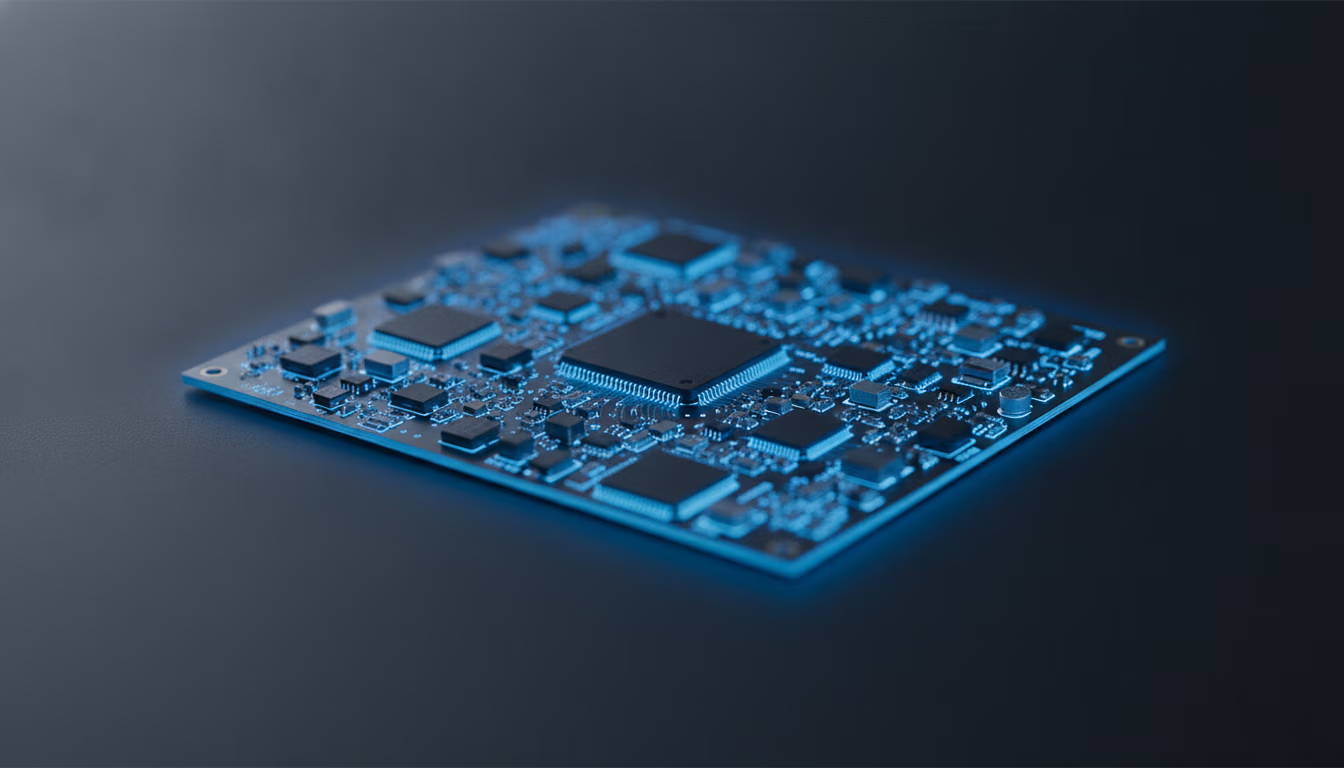
A freshly soldered board carries flux residue and other organic contamination as a matter of course — it's a byproduct of the soldering process, not a defect, but it sits directly between the board and whatever coating goes on next. That residue lowers the surface energy of the board, and a low-energy surface doesn't let a liquid coating spread evenly across it: instead of wetting out into a continuous film, the coating beads, pulls back from component edges, or leaves pinholes where it couldn't get purchase. None of that is visible until the coating cures and the board goes through qualification testing — by which point the coating has to be stripped and reapplied.
How plasma cleaning prepares the board before coating
Plasma treatment removes the organic contaminants and flux residue left behind from soldering, and in the same step raises the surface energy of the board so the coating wets and spreads evenly instead of beading. It's a dry process — no solvents, no wet-chemical undercoat step, and no rinse or disposal stream to manage — which is the main reason it has displaced the wet-chemical treatments historically used to prepare boards for coating. Low-pressure vacuum plasma in particular is suited to the delicate, densely populated boards common on conformal-coating lines, and it's the same category of process used ahead of coatings like Parylene, where uniform, defect-free adhesion is non-negotiable.
Where plasma cleaning sits in the process
Plasma cleaning is introduced as a pre-treatment step immediately before the board reaches the coating station, and the right system depends on board format and volume:
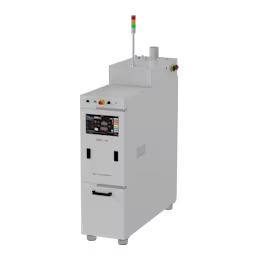
- QML-CI — an inline system with a conveyor-indexer that loads and unloads the plasma chamber in a single motion, built for 24/7 continuous processing of PCB and BGA substrates ahead of downstream coating steps.
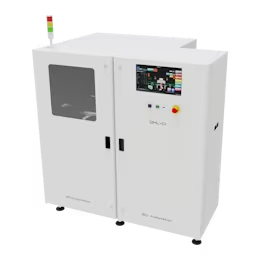
- QML-B — a super-compact inline system: at 480 mm wide it's the narrowest inline plasma platform on the market, for coating lines where footprint is the constraint, with full front-and-back access to keep maintenance fast on a 24/7 line.
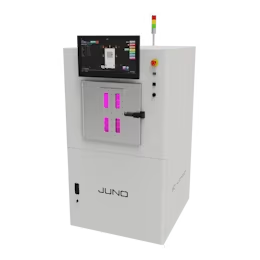
- Juno — a batch system whose reconfigurable shelves adapt to almost any assembly shape, so mixed or awkwardly shaped boards needing a plasma pass ahead of coating run together in one chamber rather than one at a time.
The reliability payoff shows up downstream, in the categories where a coating failure is least tolerable — medical devices, military and aerospace electronics, and automotive systems — where a coating that seals properly the first time is the difference between a part that survives its qualification testing and one that doesn't.

Verifying coating adhesion
The board surface should be checked for wettability before it reaches the coating station, since a board that still resists wetting after plasma treatment is a sign the chamber or recipe needs attention, not that the coating itself is at fault. After coating, uniform, continuous coverage with no beading, pinholes or edge pull-back at component leads is the visual confirmation that the surface was properly prepared — a coating that adheres unevenly across an otherwise identical batch of boards points back to the plasma step, not the coating chemistry.
Recommended systems
Related industries
Related articles
Frequently asked questions
Why does conformal coating bead up or leave pinholes on some boards?
Flux residue from soldering lowers the board's surface energy, and a low-energy surface doesn't let the coating spread into a continuous film — it beads, pulls back from component edges, or leaves pinholes instead of sealing the board.
What does plasma cleaning do to a board before conformal coating?
It removes organic contaminants and flux residue left from soldering, and raises the board's surface energy so the coating wets and spreads evenly across it.
Does plasma cleaning replace the wet-chemical prep some lines still use?
It's the reason many lines have moved away from wet-chemical undercoats: plasma is a dry process with no solvents, no rinse step and no disposal stream, and it prepares the board more consistently than a chemical wipe-down.
Which plasma system fits a conformal-coating line?
QML-CI is the inline option for continuous PCB and BGA processing; QML-B is the super-compact inline platform for coating lines where footprint is the constraint; Juno's reconfigurable shelves take mixed or awkwardly shaped assemblies in one batch ahead of coating.
How do you confirm a board is actually ready for coating, not just clean-looking?
Wettability, not visual cleanliness, is what determines coating adhesion — a board that still resists wetting after plasma treatment signals a chamber or recipe issue, and it should be caught before it reaches the coating station rather than after the coating fails qualification testing.