

Plasma Cleaning for Wire Bonding
When wire bonds fail, the bonder is rarely the cause. The surface is. Vacuum plasma cleaning fixes the surface before bonding starts.
When wire bonding starts producing inconsistent pull-test results or intermittent non-stick failures, the instinct is to check the bonder — alignment, force, ultrasonic power, capillary wear. Those checks matter, but in most persistent cases they don't find the fault, because the fault isn't in the machine. It's on the surface the machine is trying to bond to.
Why wire bonding fails on contaminated pads
Wire bonding is the last step in the assembly sequence where an electrical connection is physically formed, which makes it the point where every upstream problem finally becomes visible. Oxidation on a bond pad blocks the intermetallic formation a gold or copper wire needs to key into — there is no mechanical or thermal adjustment on the bonder that substitutes for a clean metallurgical interface. Organic residues (flux carryover, handling oils, mould-release film) sit as a physical barrier between the wire and the pad, preventing adhesion regardless of bond force. Both conditions register as a high water contact angle: untreated pads commonly test above 60°, an indicator of low surface energy and poor wettability that correlates directly with bond quality.
The failure modes that follow are specific and costly: NSOP (non-stick-on-pad), where the wire simply doesn't adhere; low pull and shear strength that passes a lot-acceptance threshold but leaves little margin before field failure; and delamination that doesn't show up until the part is in thermal cycling or in the field. None of these are wire-bonder defects in the conventional sense — the bonder executed the recipe correctly on a surface that was never ready to receive it.

How plasma cleaning restores bondability
Vacuum plasma cleaning is a pre-treatment step, introduced before the part reaches the bonder, that addresses contamination at its source instead of compensating for it downstream. Inside a vacuum chamber, an energised process gas — typically argon — strips organic residues and thin oxide layers from the pad surface at an atomic level while simultaneously raising its surface energy through activation. The shift is measurable: untreated surfaces around 60°+ contact angle drop to under 20° after treatment, and internal testing has shown pull/shear strength gains of 3x or more alongside NSOP rates falling to effectively zero on properly treated lots.
That's not a marginal improvement to a working process — it's the difference between a bonding step that occasionally works and one that works every time, because the variable that determines the outcome (surface energy) is now controlled rather than left to whatever contamination happened to arrive with the part.
Where plasma cleaning sits in the process
Plasma cleaning is introduced as a pre-treatment step immediately ahead of wire bonding, and it does not require restructuring the rest of the line. Cycle times are typically measured in seconds, so throughput on the bonder downstream is unaffected. The system choice depends on part format and volume:
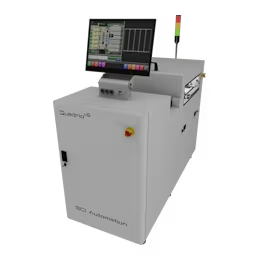
- Quadrio Alpha — a magazine-fed, semi-automatic system built specifically for lead frame processing: each frame is pulled from its magazine, plasma-treated, and returned to the same magazine, with up to five magazines run concurrently. This is the standard configuration ahead of wire bonding for lead-frame packages, with full per-frame traceability available for MES integration.
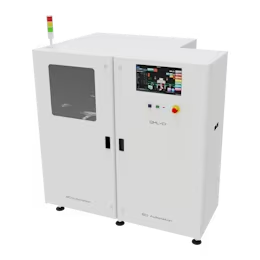
- QML-CI — an inline system with a conveyor-indexer that loads and unloads the plasma chamber in a single motion, matched to 24/7 continuous production on module and PCB lines.
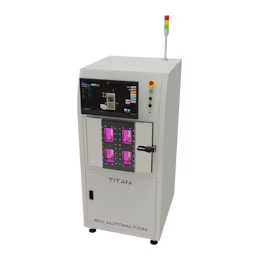
- Titan — a magazine-fed batch system for lead frames, holding up to six magazines in fixed positions so every frame is treated evenly. Because it cycles frames through the chamber in place rather than by automated pick-and-place, it is the gentle option for fragile frames or ones already carrying formed wire bonds.
Whichever configuration fits the line, the principle is the same: treat every part to the same worst-case contamination standard, rather than tuning the process to whatever the cleanest sampled part looked like.

Process control and verification
A plasma step that isn't monitored can drift quietly. A small oxygen leak into the chamber, or a pressure imbalance, can undermine an entire cleaning cycle without an obvious symptom until pull-test data starts trending down — and an oxygen leak in particular can leave oxidation marks on the very pads the process is meant to clean, so chamber integrity checks belong in the same maintenance cadence as the bonder's own calibration. Wire stock consistency and bonder parameter drift (alignment, force, heat) are the other two variables worth ruling out when defects appear, but in practice the surface-prep stage is the one lever that removes the largest and most consistent source of variation.
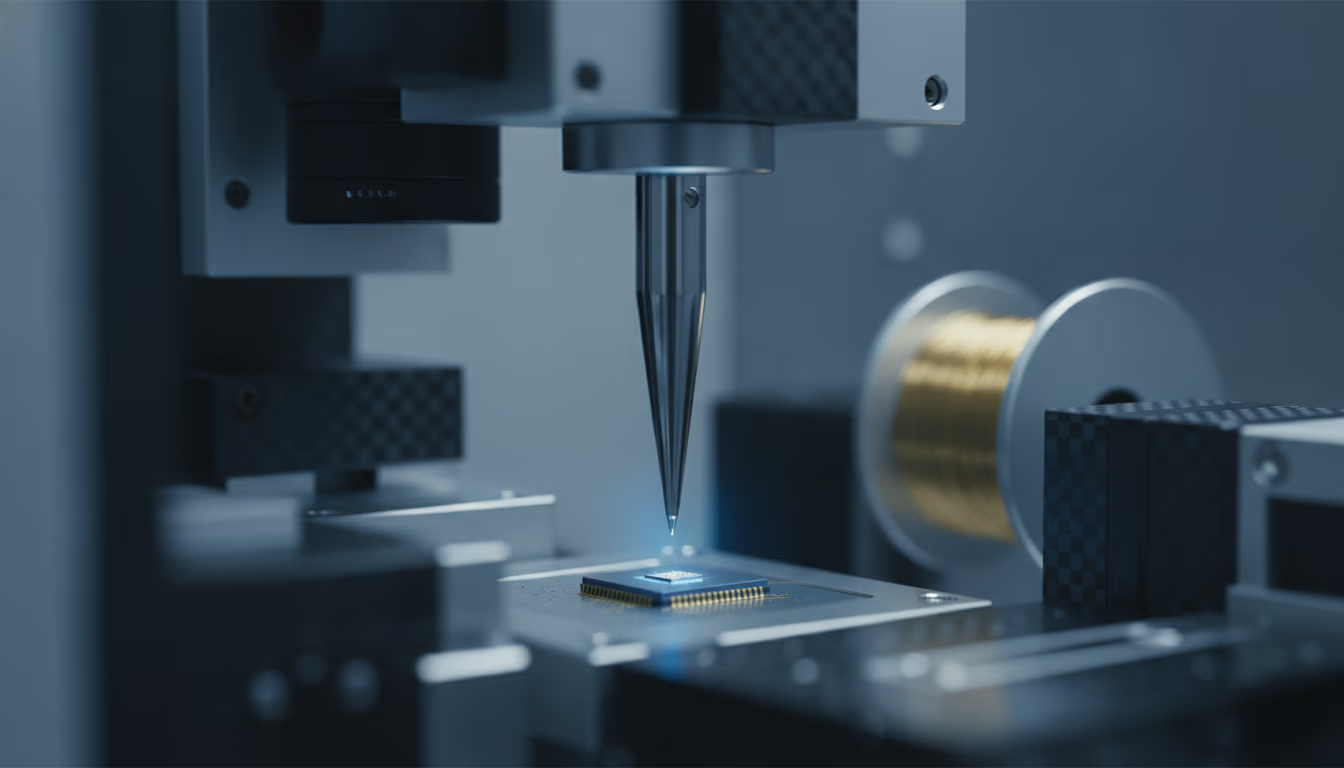
Verification should run on two levels: contact-angle measurement before and after plasma treatment as a direct, fast check on wettability, and pull/shear-test trending plus NSOP rate on the bonded output as the metric that ties the plasma step back to yield. Treated as a monitored process step rather than a black box, plasma cleaning turns wire bonding from a source of unpredictable rejects into a controlled, repeatable stage of the line.
Recommended systems
Related industries
Related articles
Why Your Wire Bonding Is Failing and How to Fix It with Plasma Cleaning
Wire bonding failures don't happen by accident, and blaming machines or operators misses the real problem.
Bond Strength and Yield: Engineering Stability into Every Frame
Bond strength isn't a constant—it's the outcome of surface prep, material control, and the process environment. When failures occur,...
How to Handle Warped Lead Frames Without Breaking Your Yield
Lead frames form the structural foundation of many microelectronic devices—but when they're warped, everything becomes more complicated....
Frequently asked questions
Why do wire bonds fail even when the bonder is running to spec?
Most persistent bonding failures trace back to the pad surface, not the machine: oxidation blocks intermetallic formation and organic residues physically block adhesion, and no bonder adjustment compensates for a contaminated surface.
What is NSOP and what causes it?
NSOP (non-stick-on-pad) is a wire bond that fails to adhere to the pad. It's driven by surface contamination — oxides or organic residue — that leaves the pad's surface energy too low for the wire to key into during bonding.
How much does plasma cleaning improve bond strength?
Contact angle typically drops from 60°+ to under 20° after treatment, and testing has shown pull/shear strength gains of 3x or more with NSOP rates falling to effectively zero on properly treated lots.
Does adding a plasma cleaning step slow down the bonding line?
No. Plasma cycle times are typically measured in seconds and the step is introduced as a pre-treatment ahead of the bonder, so it doesn't restructure the line or become the throughput bottleneck.
Which plasma system fits a lead-frame wire bonding line?
Quadrio Alpha is purpose-built for this: a magazine-fed, semi-automatic system that pulls each lead frame from its magazine, plasma-treats it, and returns it to the same magazine, with per-frame traceability for MES integration.